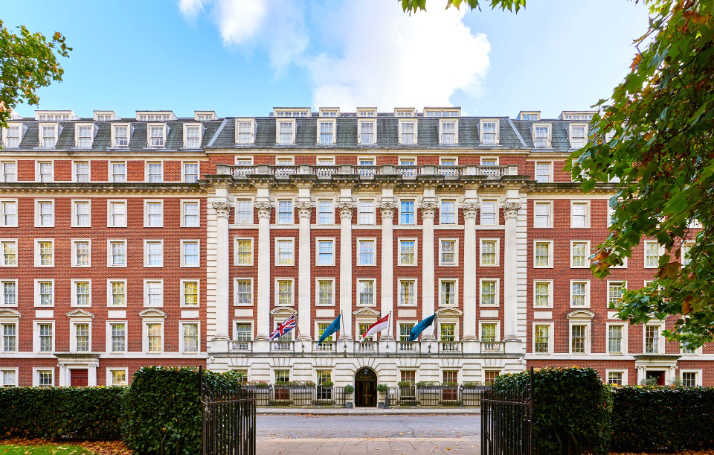
 Following extensive renovations, The Biltmore, Mayfair, is set to reopen in later this year, with brand new rooms, interiors, and dining establishments by Michelin-starred chef Jason Atherton.
A Slice
Of History
At
The Biltmore,
Mayfair
In London
Following extensive renovations that started in 2018, The Biltmore, Mayfair, is now set to reopen in the coming months. Located at Grosvenor Square, the building was first developed by Sir Richard Grosvenor in 1710 as a private residence, before being established as a hotel in 1969.
Here is a glimpse of the hotel’s storied past, its former residents, and neighbouring vicinity that has established Grosvenor Square’s prestigious address that it has today.
1728 to 1743 – Home to the mistress of King George I
Since its development as residences, the high social status of Grosvenor Square has been a constant of the estate. A number of noble aristocrats have lived there, one of whom was Melusine von der Schulenburg, Duchess of Kendal (1667 – 1743), who stayed at 43 Grosvenor Square. She was a long-time mistress to King George I, and had borne him three illegitimate children, although no marriage was ever acknowledged. In addition to being Duchess of Kendal, she also had other titles created for her, including Duchess of Munster, Marchioness of Dungannon, Countess of Dungannon, Baroness Dundalk, Countess of Feversham and Baroness Glastonbury.
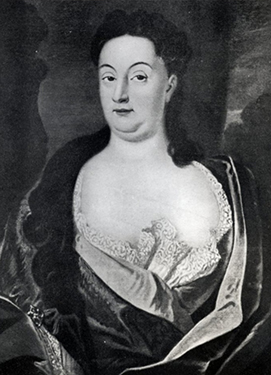 A portrait of Melusine von der Schulenburg, the Duchess of Kendal and long-time mistress of King George I. (Photo credit: Magnolia Box)
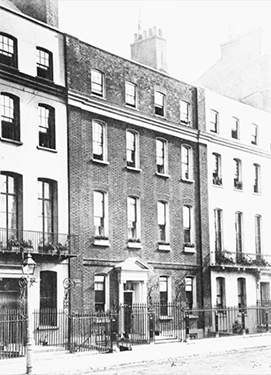 No 43, 44 and 45 Grosvenor Square, circa 1874. (Photo credit: Survey of London: Volume 39, the Grosvenor Estate in Mayfair, Part 1/British History Online)
1815 – Battle of Waterloo
The battle took place in Belgium and marked the final defeat of French military leader and emperor Napoleon Bonaparte (1769-1821), who had conquered much of continental Europe in the early 19th century. His forces were defeated by the Prussians and the British-led army of 43,000 soldiers commanded by Arthur Wellesley, the Duke of Wellington.
Following the famous victory, Major Henry Percy was instructed by the Duke of Wellington to deliver the news to London. Accompanied by Commander James White, the pair departed Belgium on June 18 and arrived in London three days later, having travelled by horse-drawn post chaise carriage and rowing boat.
Their first stop in London was at 44 Grosvenor Square, where members of the Cabinet had gathered for dinner – the very location where the hotel now stands.
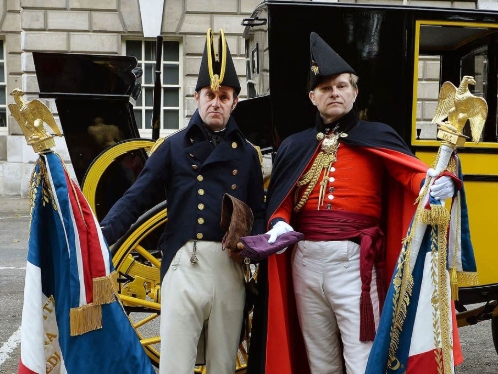
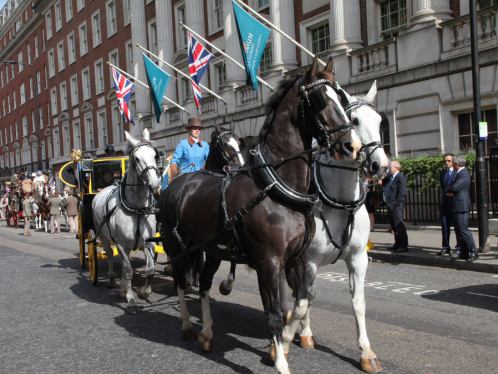
The Waterloo Dispatch, with actors as Commander James White and Major Henry Percy, in a replica horse-drawn carriage, making its way to the hotel. The hotel is at the very location where Major Henry Percy delivered news of the defeat of Napoleon Bonaparte by British and Prussian forces. The photos were taken during the British capital’s celebrations of the 200th anniversary of the Battle of Waterloo in 2015. (Left photo credit: Press Association)
1883 to 1884 – Home to Oscar Wilde
Well-known Irish poet and playwright Oscar Wilde also made Grosvenor Square his home briefly in the 1880s. His stay clearly left an impression on him, as the place made appearances in his later works – and ‘The Picture of Dorian Gray’ (1890/1891), ‘Lady Windermere’s Fan’ (1892), ‘An Ideal Husband’ (1895), and ‘The Importance of Being Earnest’ (1895).
1920s – Home to the Bentley Boys
Since its development in the 18th century, the wide, spacious houses around the square were variously extended or rebuilt. In the 1920s, the southeast corner of the square was home to four racers who had competed in the ‘24 Hours of Le Mans’, the world’s oldest active sports car race. The four – Woolf Barnato, Tim Birkin, Glen Kidston and Bernard Rubin – who were part of a group known as the Bentley Boys, were well-known for their parties and green sports cars parked outside, which led to local cabbies nicknaming the spot ‘Bentley corner’ for many years afterwards.
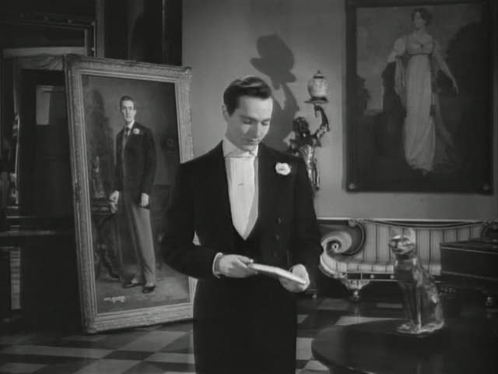 Oscar Wilde’s stay at Grosvenor Square made such an impression on him that he featured the place in his later works, such as ‘The Picture of Dorian Gray’. Pictured above is actor Hurd Hatfield as the titular character in the 1945 film adaptation of the novel, which had scored wins at the Academy Awards and Golden Globe Awards in 1946. (Photo credit: Wild Culture)
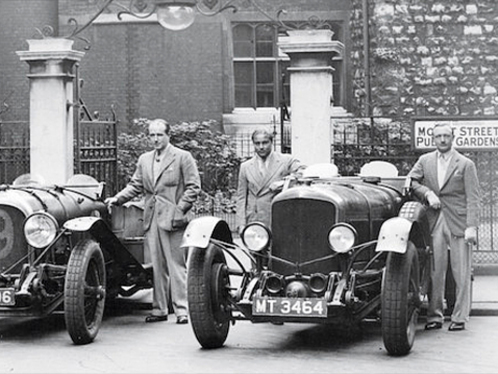 Three of the four Bentley Boys who lived luxurious lives at Grosvenor Square: (L-R) Bernard Rubin; Woolf Barnato; and Tim Birkin. This photo was taken in 1924. (Photo credit: The Rake)
1939 to 1945 – World War II
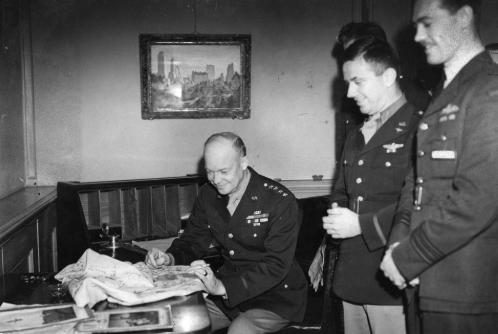
Across the street from Millennium Mayfair is 20 Grosvenor Square, formerly the wartime headquarters of United States General Dwight D Eisenhower (who was elected as President in 1953). Dubbed “Eisenhower Platz”, the place also served as the home of the US Naval Forces Europe until the base was moved to Italy in 2009. The building has since been developed into luxury residences.
The area around the square has also been home to American presence since 1785, when former President John Adams first moved there as the US’ first ambassador to the UK. The former US Embassy was also located there from 1960 to 2018.
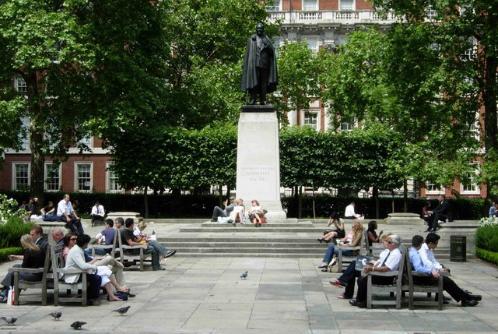
Grosvenor Square was formerly the wartime headquarters of United States General Dwight D Eisenhower. Pictured left is General Eisenhower meeting with military aides in 1944. (Photo credit: Dwight D Eisenhower Presidential Library & Museum) Pictured right is a memorial statue of Franklin D Roosevelt, then-President of the United States during World War II, and a strong ally of Britain. (Photo credit: Stephen McKay/CC BY-SA 2.0)
2006 – Poisoning of Alexander Litvinenko, former KGB officer
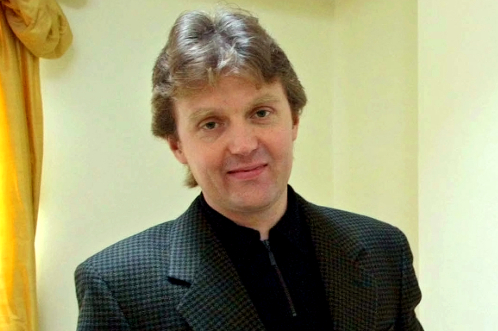
In 2006, Alexander Litvinenko, former officer of the Russian Federal Security Service (FSB) and Committee For State Security (KGB) became the first confirm victim of lethal polonium radiation. In 2000, he defected, escaping prosecution in his home country and received political asylum in the UK a year later.
He suddenly fell ill on 1 November, after meeting with former KGB colleagues, bodyguard Andrey Lugovoy and agent Dmitry Kovtun, at Pine Bar at Millennium Mayfair. After being hospitalised, it was found that he was suffering from radiation sickness. After his death 22 days later, it was found that he had significant amounts of the radioactive polonium in his body. Polonium is also a critical component of early nuclear bombs.
After his death and police investigation into the case, it was found that he was poisoned by drinking a cup of tea that had been tainted with a fatal polonium dose. It was also a case of “third time’s the charm” – based on discovered polonium trails, detectives posit that the assassin duo had made two failed attempts to poison Litvinenko before finally succeeding.
In 2006, former Russian spy Alexander Litvinenko (left) was fatally poisoned by drinking a cup of tea that had been contaminated with polonium at the former Pine Bar at Millennium London Mayfair (right). The Pine Bar closed in 2018 when the hotel renovations started. (Left photo credit: Associated Press)
2019 – Reopening of The Biltmore, Mayfair
The property, located at 44 Grosvenor Square, was first established as a hotel in 1969 as the Britannia Hotel by Grand Metropolitan Hotels. In 1981, the hotel was renamed Britannia InterContinental London, after Grand Metropolitan acquired InterContinental Hotels.
It changed hands in 1996 when the hotel was purchased by Millennium & Copthorne (which was then 55% owned by CDL Hotels International), who renamed it Millennium Britannia Hotel. The hotel underwent a rebranding as the 336-room Millennium Hotel London Mayfair after a renovation in 2000.
Half a century after the hotel was first established, the 308-room property will reopen later this year as The Biltmore, Mayfair, operated by LXR Hotels & Resorts under Hilton Hotels, boasting brand new interiors and dining establishments helmed by Michelin-starred chef Jason Atherton.