A pioneer in sustainability, City Developments Limited (CDL) was the first organisation in Singapore to begin publishing sustainability reports in 2008 and the first Singapore firm to issue a green bond in 2017. Proceeds from its first green bond were used to repay a loan spent on retrofitting and upgrading efforts at Republic Plaza, its flagship headquarters, to maintain high levels of building performance in energy and water management.
care
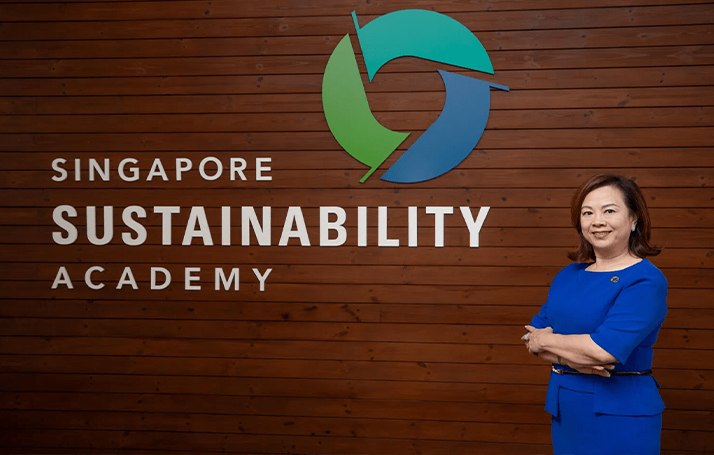
As CDL’s first Chief Sustainability Officer, Ms Esther An quickly championed an ethos that still guides its business practices today: “Conserving as we Construct”.
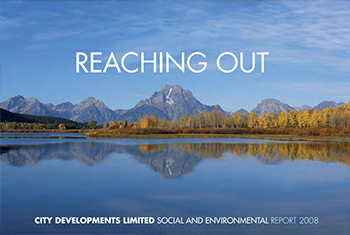
CDL’s first dedicated report which describes its economic, social and environmental activities. It provided an in-depth look at its operational functions in project development and property management of residential and commercial developments in Singapore.
CDL’s Chief Sustainability Officer Ms Esther An shares, “At the time, we had to explain to local banks how green financing would work for buildings. Today, sustainable finance is becoming mainstream, and banks are well versed in supporting green buildings and climate action.”
In 2007, it launched a “1°C Up” campaign to encourage its tenants to raise their air-conditioning temperature to save energy. Over the years, it has led green efforts, for example, energy-efficient retrofitting and initiatives that have saved approximately S$42 million in energy savings from 2012 to 2023.
In 2014, CDL was the first Singapore real estate company to launch the Green Lease campaign for its tenants, with the support of the Building and Construction Authority (BCA). In 2017, it achieved 100% participation from its retail and office tenants.
In 2024, it became the first corporation in Singapore to adopt the global Taskforce on Nature-related Financial Disclosures (TNFD) framework. In its latest sustainability report, it set out its strategy and actions to minimise its impact on nature and mitigate nature-related risks, among other TNFD-recommended disclosures.
Esther says: “In the early days of our sustainability journey, most in the built environment sector saw sustainability only as a cost. Now, more businesses consider sustainability initiatives an important investment to generate long-term value, to reduce their climate-related risks, capture opportunities, and get ahead of environmental regulations. We’re glad that we started our environmental journey early and are pioneers in many areas, including reporting on the Task Force on Climate-related Financial Disclosures in 2017, and the Taskforce on Nature-related Financial Disclosures, which we published in March this year.”
The Four I’s of Sustainability
She notes that real estate companies have a social responsibility to reduce their carbon footprint, given that buildings and construction account for nearly 40 per cent of global greenhouse gas emissions. “Apart from new developments, it is crucial to better manage buildings and their operations, and continual efforts to retrofit older buildings are key because some 70 per cent of buildings that exist today will still be around in 2050.”
CDL has articulated four key pillars in its sustainability strategy: Integration, Innovation, Investment and Impact. “Integration is critical to effectively embed sustainability into your business strategy and operations. Innovation enables you to accelerate change and impact by developing or adapting solutions.”
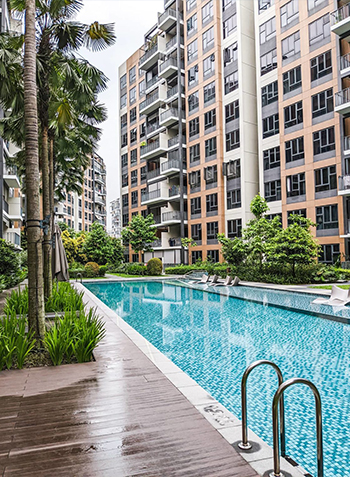
CDL was the first developer in Asia to adopt Prefabricated Prefinished Volumetric Construction (PPVC) for a large-scale residential development. (Pictured: Brownstone Executive Condominium launched in 2015).
“Investment is essential to deploy technologies and solutions for decarbonisation. Businesses with strong sustainability strategy and performance have better access to responsible investment and sustainable finance. Most, if not all, companies need the support of banks and investors for long-term growth.”
As for impact, Esther points out that every business decision matters. She explains: “Everything we do has positive or negative consequences, or both. That is why sustainability reporting is essential. What you don’t measure, you don’t know, and what you don’t know, you can’t manage. If you want to improve performance and be future-ready, you need to identify and work on gaps.”
By tracking past and present performance, companies can embark on and hone their forward-looking scenario planning. “The cost of inaction can be substantial if companies are not prepared for the physical and transitional risks that lie ahead. CDL has conducted three rounds of climate change scenario studies since 2018. This has allowed us to gain insight into potential risks caused by more severe and frequent climate threats, new regulations and changing expectations of investors, financiers and insurance companies.”
Going Green for the Long Haul
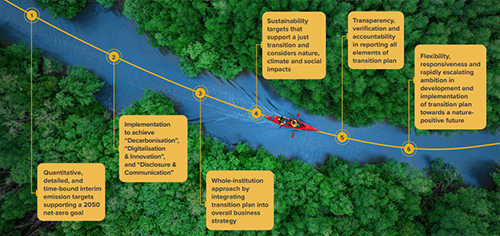
CDL’s climate transition plan sets out its interim and long-term emissions reduction targets and outlines the strategies and measures to meet its targets. The action plan lays out how CDL will achieve its sustainability strategy by pivoting existing assets, operations, and business models towards a trajectory that aligns with the latest and most ambitious climate science recommendations.
As CDL forges ahead in sustainability, it has always had the full support of its board and management. She highlights: “Leadership commitment is key to sustainability integration. More companies have been stepping up on building or enhancing their sustainability capabilities in recent years. To be effective, the sustainability portfolio needs to be empowered as an independent and dedicated unit for it to ensure that ESG can be integrated into every business and operational unit. Parking sustainability under the remit of risk management, finance or corporate communications is not advisable as the expertise required is very different.”
She shares that the Group Chief Executive Officer, Mr Sherman Kwek, is dedicated to further enhancing CDL’s sustainability leadership by integrating it into the company’s GET (Growth, Enhancement and Transformation) strategy he has established. She says: “I think the fact that CDL is a listed company with Hong Leong Investment Holdings as its major shareholder is an advantage. Like many successful global family businesses, it takes a long-term view to sustain growth by future-proofing its business for investors and generations to come.”
She is also doing her part to ensure the firm’s continued care for the environment and pursuit of ESG excellence, by nurturing the next generation of sustainability leaders within the company and the community at large.
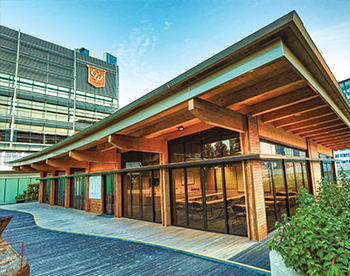
The Singapore Sustainability Academy (SSA) is the first major People, Public and Private (3P) ground-up initiative and zero-energy facility in Singapore dedicated to capacity building and thought leadership for climate action and the SDGs. It involves an extensive partnership with six government agencies and 15 industry and non-governmental organisation (NGO) partners. As of 31 December 2023, the SSA has hosted over 970 sustainability-related training programmes and advocacy events, attracting close to 33,400 attendees. As the pot of seeds for sustainability, it features 3,200 square feet of solar PV panels on its roof, generating 60,000 kWh per year.
On building sustainability talents and the future of SSA, she explained, “I hire people who are passionate about sustainability, and help them to develop the skills and expertise they need. CDL has long been committed to raising awareness and building sustainable communities through its active stakeholder and community engagement programmes. Its Singapore Sustainability Academy, the country’s first ground-up initiative on sustainability, supported by 6 government agencies and 15 founding industry and NGO partners, has hosted more than 1,000 events and training courses for some 35,000 visitors since its opening in June 2017. With a fast-growing network, the Academy is a strong force for positive change and impact.”
