 Millennium Knickerbocker Chicago has a rich history that spans nearly a hundred years.
A Peek Into
The Colourful
History Of
Millennium
Knickerbocker
Chicago
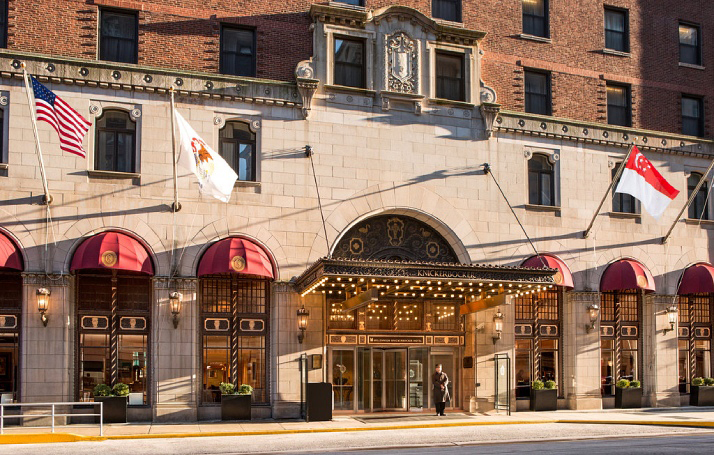
Located around Chicago’s Magnificent Mile commercial district, the historic Millennium Knickerbocker Chicago is the epitome of classic Chicago style, with an elegant Gothic-Revival exterior that encloses a lavish space. As the 306-key hotel celebrates its 94th birthday on 16 May, Hi Life takes a look at the fascinating history and many intriguing identities the hotel has had since its establishment in 1927.
Welcome to the Roaring 20s
Chicago was the historical epicentre of the 1920s, with gin, guns and glamour. On 16 May 1927, the booming metropolis welcomed a new US$3 million architectural masterpiece that was history in the making.
It was built by notable architects Rissman & Hirschfield, who had also built many other Chicago skyline structures, with construction completed in less than a year. When the 14-storey gothic-inspired gem first opened its doors, it was named Davis Hotel, after its first General Manager, James H. Davis, and renamed Knickerbocker Hotel after it was taken over by Allan Hurst in 1931.
 The original Davis Hotel that was completed in 1927, with an insert of a current photo of the hotel’s Crystal Ballroom, which feature’s Chicago’s only illuminated dance floor. (Photo credit: Fitzgerald Associates Architets)
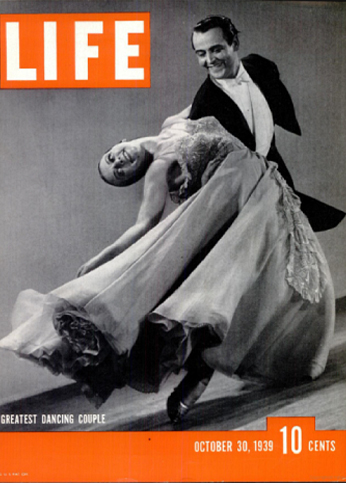 Dance duo Veloz and Yolanda, had dazzled audiences with a ballroom dance performance at the hotel’s Crystal Ballroom. The couple were once of America’s most famous dance acts and were featured on the cover of Life magazine.
The lavish space housed the distinctive Crystal Ballroom, which features Chicago’s only illuminated dance floor. During the hotel’s early years, guests could watch the famous dance act Veloz and Yolanda perform. The husband-and-wife ballroom dance duo was one of America’s most famous dance acts and were on the cover of Life magazine in October 1939. During a performance, Yolanda’s heels had cracked the floor and a glass square was quickly replaced in under 60 seconds, ensuring that the show went on.
Today, the Georgian-style Crystal Ballroom still remains the showpiece of the hotel’s 18,500 square feet of event and meeting space, with its expansive 25-foot gilded dome ceiling, though the flooring is now made of plexiglass.
A secret casino and speakeasy
Legend has it that when the stock market plummeted and Prohibition reigned, Chicago mobster Al Capone’s older brother, Ralph, ran a speakeasy and casino from the penthouse floor. Only one of the hotel’s three passenger lifts could reach the top floor, making it an ideal location for the illegal rooms, since access had to be controlled.
Adding credibility to this story of connections to a shady underworld was a secret door that led to a stairway, which was discovered during a remodelling in the 1980s. This door was allegedly cut by the gangsters to help them escape down to the 13th floor via back staircase in case of police raids.
A short stint as the Playboy Towers Hotel
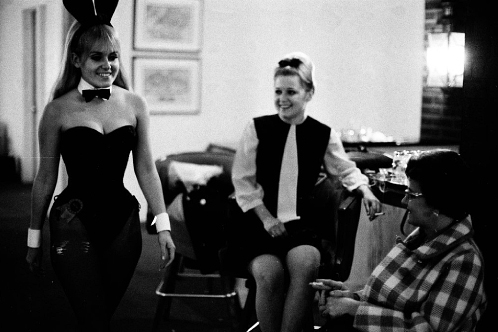 As Hugh Hefner’s Playboy Enterprises empire expanded, he opened the Playboy Club in Chicago in 1960 prior to acquiring the hotel. Pictured in this 1968 photo are women interviewing for Playboy Bunny positions at the Knickerbocker Hotel. (Photo credit: Chicago History Museum)
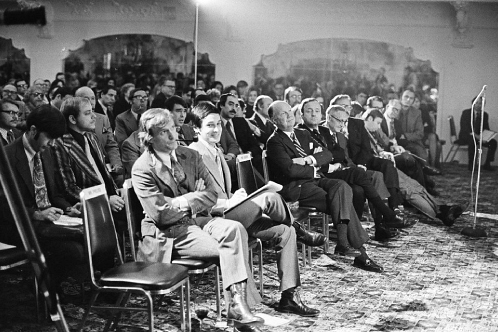 Hugh Hefner and other shareholders of Playboy Enterprises Inc at the firm’s annual meeting held at the Playboy Towers’ Grand Ballroom in 1972. (Photo credit: Chicago History Museum)
In 1970, Hugh Hefner and Playboy Enterprises purchased the property and operated it as the Playboy Towers Hotel, which expanded Hefner’s Playboy empire in Chicago, where he was born. When Playboy took over operations, the property was also remodelled, with convention facilities enlarged.
Aside from having regular hotel guests and Playboy bunnies, the hotel was also host to the first official Wizard World Chicago Comic Con, which was held from 6 to 8 August 1976. The event, also known as Chicago Comicon, drew some 2,000 participants to meet with special guests including Marvel Comics figurehead Stan Lee and DC Comics President Jenette Kahn.
That same year, Playboy Enterprises ran into money troubles and the name ‘Playboy’ was removed from its name, becoming just Towers Hotel. The property was then sold in 1986, and had its name reverted to Knickerbocker Hotel.
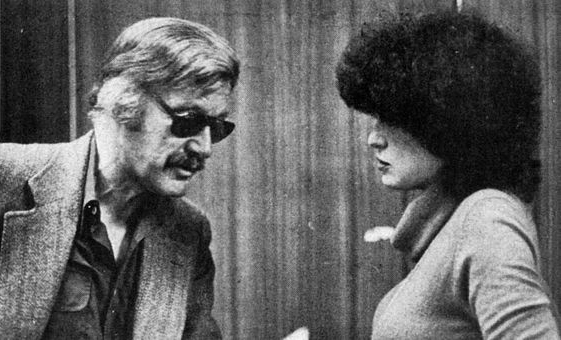 Marvel legend Stan Lee and DC Comics then Publisher and current President Jenette Kahn pictured together in 1976. (Photo credit: Pinterest)
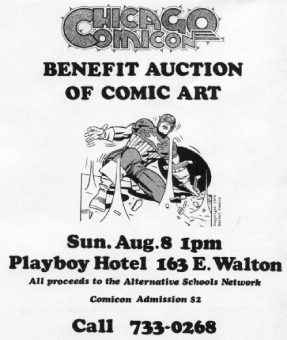 A Chicago Comicon poster from 1976 by Marvel artist Jack Kirby. Kirby’s famous co-creations include Captain America, the Fantastic Four and Iron Man. (Photo credit: Comic Art Shop)
Famous guests through the years
Throughout the years, the hotel has welcomed many well-known visitors. Other celebrities and famous faces that have been at the hotel include rock stars like The Rolling Stones, boxing legend Muhammad Ali, and American actress Daryl Hannah.
In 1952, the Knickerbocker Hotel hosted the California delegation of the Republican National Convention. Among its ranks were leader Governor Earl Warren, who later became the Chief Justice of the US Supreme Court from 1953 to 1959, and Richard Nixon, who became Vice President of the United States under President Dwight D. Eisenhower, and later was himself the 37th President. During that same presidential campaign, John F. Kennedy, then a US Senator from Massachusetts, who went on to becoming the 35th president, also stayed at the hotel.
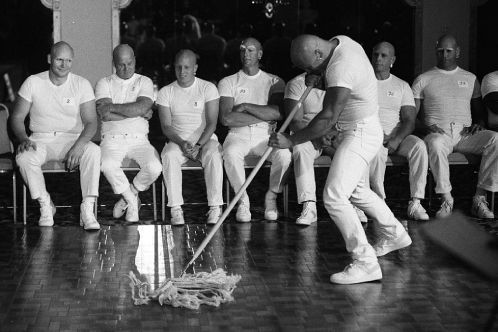
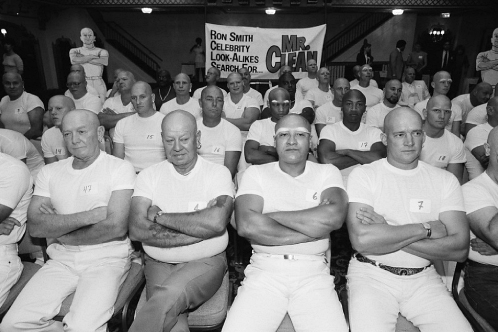
Bald musclemen gathered at Knickerbocker Hotel for the Mr Clean Celebrity Lookalike contest. Other than just their physical appearance, the contestants were put through a ‘Mr Clean triathlon’, comprising a personality test, and segments which judged their fitness calisthenics and eagerness to help out. (Photo credits: Chicago History Museum)
Perhaps the funniest “celebrity” sighting was in 1985, when a Mr Clean Celebrity Lookalike contest was held in celebration of the cleaning product’s 25th anniversary. Dozens had shown up to the hotel in hopes of being deemed the best human version of the cartoon mascot of Mr Clean. Finalists had to perform cleaning tasks to demonstrate their eagerness to help out (a key Mr Clean trait), with the winner being awarded a $30,000 personal appearance contract to take part in a 15-city tour.