 The new 2019/2020 REDAS management committee toasting to prosperity for the Singapore property market (L-R): Honorary Assistant Secretary and Wing Tai Land Senior General Manager Ms Quek Chay Hoon; immediate past President and Far East Organisation Executive Director Mr Augustine Tan; Honorary Patron and CDL Executive Chairman Mr Kwek Leng Beng; Singapore Finance Minister Mr Heng Swee Keat; current President and CDL Group General Manager Mr Chia Ngiang Hong; Honorary Patron and Pontiac Land Managing Director Mr Kwee Liong Keng; and First Vice President and Guocoland Group Managing Director Mr Cheng Hsing Yao.
Singapore
Developers
Call For
Review Of
Property Measures
By Singapore
Government
The Real Estate Developer’s Association of Singapore (REDAS) is the representative body for the property sector in Singapore. Each year, the association organises a Spring Festival Lunch to bring together members and various industry stakeholders and reinforce active partnership. The Guest-of-Honour at the luncheon this year was Minister of Finance Mr Heng Swee Keat.
Representing REDAS, its newly appointed President Mr Chia Ngiang Hong, also CDL Group General Manager, highlighted challenges in the current property market, and why some of the cooling measures (implemented in July 2018) need to be tweaked. As part of the measures, the government raised the Additional Buyer’s Stamp Duty (ABSD) for individuals by five percentage points, while entities faced a 10 percentage point hike. The loan-to-value limits were also tightened.
This article was first published in EdgeProp Singapore on 22 February 2019.
REDAS said that the private sector could help “make the policies better and more targeted”. This was in response to cooling measures introduced in July last year, namely the additional buyer’s stamp duty (ABSD) for developers, which doubled to 30% on land acquisitions. The time frame to develop and sell all residential projects, regardless of size, has been capped at five years.
Speaking on behalf of REDAS during its Spring Festival Lunch, Mr Chia shared that the policy could have partly accounted for the escalation in land prices in the past two years, as developers had to exhaust their inventory at the same time. He called for “some flexibility” for the time frame, to help curtail “the building of the project development cycle”. He cautioned that without a review of the ABSD, the ‘land grab’ situation that happened in the past two years could repeat, and prices of the property end-products could increase when land prices go up.
Reviewing of loan-to-value (LTV) limits for first-time homebuyers was also a suggestion that REDAS provided, which would allow greater flexibility for first-time homebuyers. The government can make it easier for public housing upgraders to own private homes by reviewing the timing of the upfront payment for ABSD so as to ease their cashflow planning.
“As a long-term stakeholder in Singapore’s success, REDAS wishes to facilitate a stable and sustainable property market, especially when over 90% of Singaporeans are homeowners,” said Mr Chia.
 Sharing a laugh at the annual REDAS Spring Festival Lunch (L-R): Mr Kwek Leng Beng; Mr Heng Swee Keat; Mr Chia Ngiang Hong; and Mr Kwee Liong Keng.
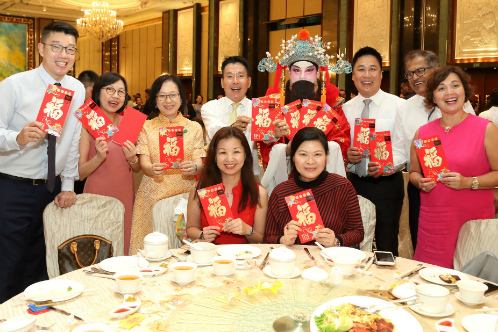 All smiles for the CDL team as they took a photo with the ‘God of Fortune’ (Standing, L-R): Business Development & Investments Head Mr Gerald Yong; Asset Management Vice President Ms Lau Li Chin; Customer Service Vice President Ms Foo Chui Mui; CDL China CEO Mr Mark Yip; Sales & Marketing Vice President Mr Jimmy Hee; Hong Leong Group Corporate Affairs Head Mr Gerry De Silva; Property Development Deputy Head Ms Tay Seok Cheng. (Seated, L-R): Sales & Marketing Senior Vice President Ms Adeline Ong; and Property Development Executive Vice President & Head Ms Lee Mei Ling.
Market to drift sideways
REDAS expects the market to drift sideways amid slower GDP growth and prevailing cooling measures this year. In the second half of 2018, market sentiment was affected by the impact of policy overhang coupled with global economic challenges, and residential transaction volumes fell 17% for the year. Mr Chia noted that the surprise cooling measures also rattled the Singapore financial market and property stocks were heavily punished.”
At the end of 4Q2018, URA data showed that there were 54,332 uncompleted units including executive condominiums. Of these, 35,649 were unsold, compared with 31,295 units in 3Q2018, which was a quarter-on-quarter increase of 13%.
“Adding this number to a potential supply of 9,800 units including ECs from Government Land Sales and awarded en bloc sale sites that have not been granted planning approval yet, 45,449 units are estimated to be available for sale in the next two years,” says Chia.
Amid a subdued market outlook and the increase in ABSD for land acquisitions, he expects developers’ appetite for land acquisitions to be lacklustre. This is evident in recent en bloc tenders that have closed without any bids, he says.
Growth in office and hospitality sectors
REDAS also noted that there are opportunities for growth in quality office spaces. The sector saw recovery in 2018, buoyed by the growth in the tech sector and expansion of co-working spaces in the central business district.
At the same time, new office buildings are equipped with advanced technology, while older buildings are being refurbished and repositioned to meet demands.
REDAS expects the hospitality to continue performing well, with the completion and opening of Jewel Changi Airport this year, the new retail and lifestyle complex at which will house over 280 retail and dining stores and new attractions. Consequently, he expects hotel revenue to continue to rise, though cautioning that tourist arrivals could be affected by geopolitical and macroeconomic uncertainties.
 According to Colliers’ Head of Office Services Mr Duncan White in September 2018, growth in the co-working sector will remain robust, with footprint rising by an estimated 30-35% year-on-year. Pictured above is the co-working space at Distrii Republic Plaza.
 Jewel Changi Airport, the new retail and lifestyle complex by Changi Airport will include attractions, a hotel, aviation facilities, and over 280 retail and dining outlets. (Photo credit: Jewel Changi Airport Development)
Collaboration with the government
Underscoring its commitment to working closely with the government on the next phase of nation-building, REDAS has put forth a REDAS Position Paper advocating “deeper engagement and mutually beneficial collaborative partnerships with various partners in the value chain.”
The association has also actively participated in various government Industry Transformation Maps (ITMs) and new initiatives. REDAS is also keen to collaborate with the government on its move to reinvent Singapore as a Smart Nation.
Mr Chia said, “It is thus imperative that we look at how we can harness technology and innovation to connect all sector stakeholders to achieve the ultimate goal of improving the liveability and sustainability of our built environment.”
Integration of online-offline models
During his speech, Singapore Finance Minister Mr Heng Swee Keat acknowledged the role REDAS plays in Singapore’s nation-building journey. This year marks the 60th year of Redas, which was established in 1959.
“Urban development would not have been possible without the support, capital and expertise of private developers and companies,” says Heng. “For example, many of our private housing, office towers, hotels and retail developments are built by the private sector.”
