Lunar New Year (also known as Chinese New Year or Spring Festival 春节) is a festival that celebrates the new year following the traditional Chinese calendar. The celebration lasts fifteen days, capping off with the Lantern Festival (or Yuanxiao Jie 元宵节). This year, the first day of Chinese New Year took place on February 5 and marked the start of Year of the Pig.
getting to know you
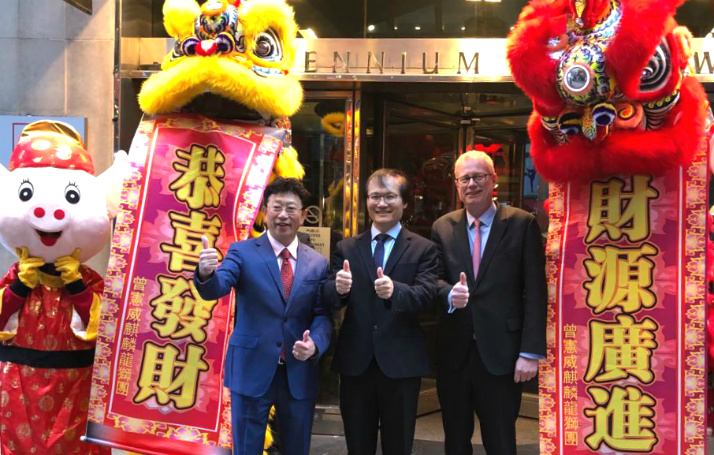
Millennium Broadway New York Times Square rang in the Year of the Pig with a traditional lion dance (L-R): General Manager and Owner’s Representative Mr Benedict Ng; Chief Financial Officer Mr Kok Kee Chong; and Senior Vice President Mr Erik Anderouard.
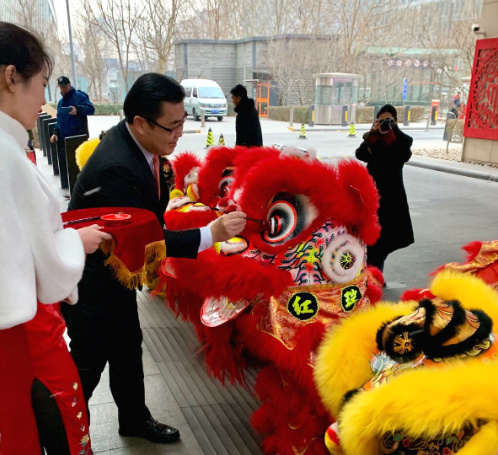
Millennium Hotels and Resorts Vice President for Operations – Greater China, Mr Bernard Chong, dotting the eyes of the lion ahead of its first lion dance.
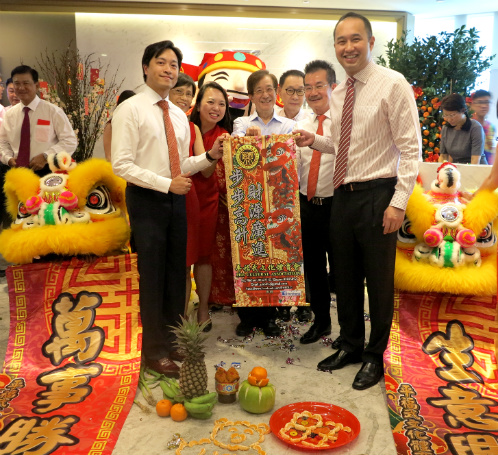
CDL management ushering in the new year with the lion dance (L-R): Group Chief Strategy Officer Mr Kwek Eik Sheng; Lead Independent Director Ms Jenny Lim; Group Chief Financial Officer Ms Yiong Yim Ming; Non-Executive and Independent Director Mr Philip Yeo; Director Mr Koh Thiam Hock; Group General Manager Mr Chia Ngiang Hong; and Group Chief Executive Officer Mr Sherman Kwek.
The years follow the Chinese Zodiac (or shengxiao 生肖), a 12-year cycle with an animal assigned to each year. In Chinese mythology, the Jade Emperor decreed that the years would be named for each animal in the order that they reached him after crossing a river. Though there are variations to the details of the folk tale, the 12 animals that reached the Jade Emperor are, in order, Rat, Ox, Tiger, Rabbit, Dragon, Snake, Horse, Goat, Monkey, Rooster, Dog, and Pig.
A major holiday in Greater China, the festival is also celebrated in countries with significant Chinese populations such as Singapore and Malaysia, though certain customs have changed over the years.

Dating back to the Song Dynasty (960–1279), the Pencai or Poon Choy in Cantonese (which when translated means “basin dish”), is a pot full of braised Chinese New Year delicacies ranging from abalone, dried oysters to sea cucumber and fish maw, such as the Pencai served at Grand Copthorne Waterfront’s Food Capital (pictured).
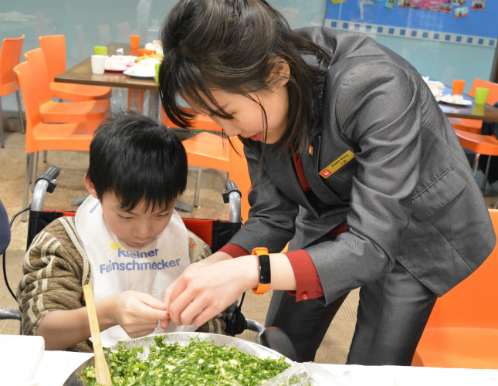
For Chinese New Year, Grand MIllennium Beijing invited children from Meng En Child Welfare Home for a festive celebration, where the children beneficiaries had a fun time with making dumplings with hotel management and staff volunteers. Shaped like gold and silver ingots, dumplings are often eaten during Spring Festival celebrations and other special occasions, representing wealth and fortune.
The celebration typically kicks off on the eve of Lunar New Year, with a reunion dinner (团圆饭 or 团年饭) during which family members gather together for a meal. Considered one of the most important get-together meals of the year, there are some must-have dishes for this dinner:
Lohei or yusheng (魚生) are a must-have for Chinese New Year, and is especially popular in Chinese communities in Singapore, Malaysia and Indonesia. It is a ‘prosperity toss’, consisting of raw fish (usually salmon, though there are other versions using abalone and other seafood), shredded vegetables, five-spice powder and pepper, oil and plum sauce, and crackers. Each ingredient also has a special meaning. For example, shredded carrots are added, as the word 红 (hong) in its name 红萝卜 is a homophone to 鸿 (hong) 鸿运当头, the Chinese saying for good fortune approaching. It is a lively dish to have, as diners will mix the dish together, tossing the ingredients high while saying various auspicious wishes.
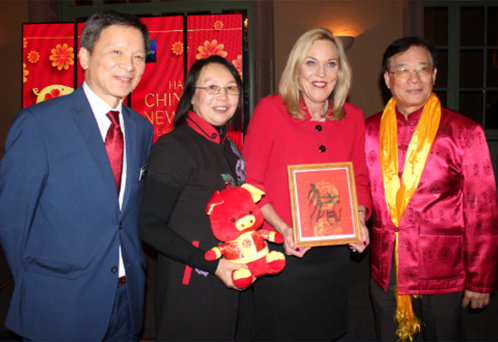
(L-R) Millennium Biltmore Los Angeles General Manager and Owner’s Representative Mr Jimmy Wu; Chinese Calligraphy Artist; Los Angeles County Supervisor Ms Kathryn Barger; and Paper-Cutting Artist at the hotel’s Lunar New Year celebration.
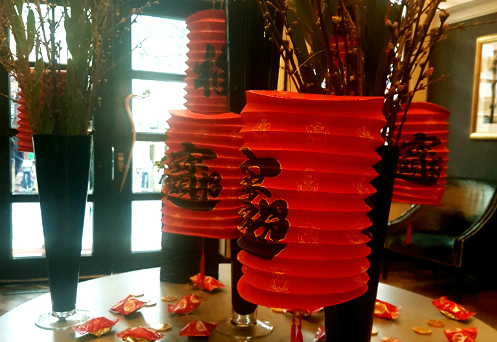
Lunar New year decorations welcomed guests at the lobby of The Bailey’s Hotel in London, with lanterns, pussy willow flowers and gold coins.
Hotpots or steamboats are often the centrepieces of many reunion dinners. For one, it’s convenient to prepare, and also creates a sense of togetherness as people all sit around the pot to cook and eat together. Fish dishes are also popular, as in Mandarin, fish (鱼) has the same pronunciation as 余, which means surplus or extra, and symbolises have a surplus of food and money every year. Another dish found during the festive season is Treasure pot, also known as pen cai (盆菜) in Mandarin and poon choi in Cantonese. It is a dish filled with meat and seafood delicacies, and sea moss. With the appearance of a clump of black hair, sea moss is also known as fat choy (发菜), which sounds similar to the ‘striking it rich’ in both Mandarin and Cantonese, making it a popular ingredient during the season. Dumplings also hold a special significance during the Spring Festival. Shaped like Chinese gold and silver ingots used in the past, they represent wealth and fortune.
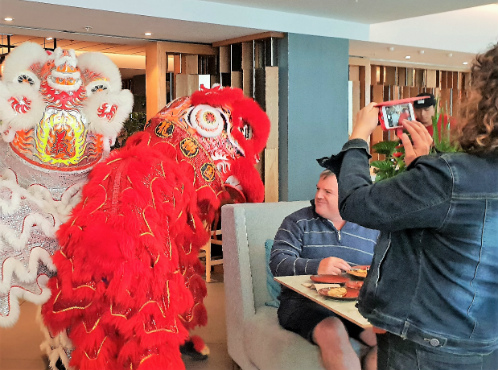
After an energetic performance with firecrackers, the lions made their way into M Social Auckland's Beast & Butterflies restaurant to bless the place with good fortune, to the delight of guests.
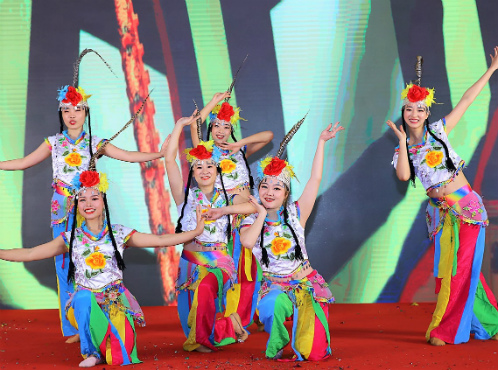
At Millennium Harbourview Xiamen's Lunar New Year party, staff were entertained by special performances put up fellow colleagues from each department, such as the traditional dance item pictured above.
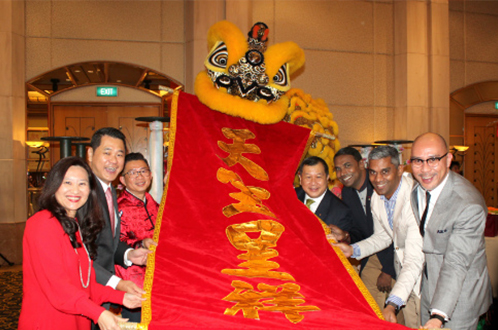
General managers from Millennium Hotels and Resorts Singapore gathered for a festive lohei dinner with the six hotels’ sales teams and clients (L-R): Ms Jacqueline Ho from M Hotel; Mr Kung Teong Wah from Copthorne King’s Hotel; Mr Andrew Tan, Millennium Hotels and Resorts Vice President of Sales; Mr Cheong Hai Poh from Grand Copthorne Waterfront; Mr Pjey Mayandi from Studio M; Mr Yogeswaran Veersamy from M Social Singapore; and Mr Byron Chong from Orchard Hotel.
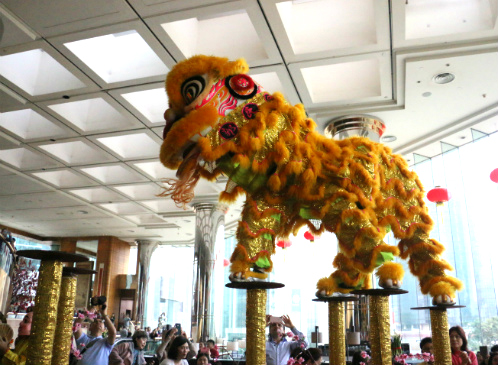
At JW Marriott Hong Kong, guests were greeted a vibrant lion dance performance, which included exciting acrobatic stunts.
Legend has it that a monster Nian (年) would terrorise villages once a year, eating people and livestock. Through the years, the villagers found that the monster was afraid of the colour red and loud noises. This led to the tradition of wearing red, hanging red decorations such as lanterns, and playing with firecrackers during the festive season.
The lion dance (舞狮), or specifically the Chinese Southern Lion (南狮) plays on this myth. The lion is associated with the monster Nian, and is performed by two people, one as the head and the other as the body. The performance combines the mimicking of a lion and acrobatic stunts such as lifts and jumps, and is accompanied by loud drums and cymbals. During Chinese New Year, the performance also includes other customs such as “plucking the greens”, or 採青, where the lion plucks an auspicious green lettuce on a table or hung up high. The lion dancers will also toss oranges, gold coins and other trinkets to spectators, and it is considered lucky to catch one of these items. In Singapore, the lion will also use mandarin oranges to reveal a set of auspicious numbers for the lottery. Before its first performance, a special ceremony is done to wake the lion up. This involves dotting the lion’s eyes (点睛) as a symbol of giving life.
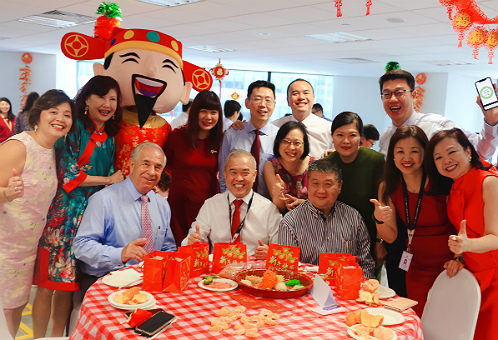
Full tummies and happy faces at CDL’s Chinese New Year lunch (Standing, L-R): Property Development Deputy Head Ms Tay Seok Cheng; Le Grove Serviced Residences Vice President Ms Patricia Chan; Investor Relations and Corporate Communications Head Ms Belinda Lee; Treasury Senior Vice President Mr Lim Whee Kong; Customer Service Vice President Ms Foo Chui Mui; Capital Market Senior Vice President Mr Mark Lim; Property Development Executive Vice President & Head Ms Lee Mei Ling; Business Development & Investments Head Mr Gerald Yong; Sales & Marketing Senior Vice President Ms Adeline Ong; Chief Sustainability Officer Ms Esther An. (Seated, L-R): Tower Club General Manager Mr Peter Schori; Property Development Executive Vice President Mr Daniel T’ng; and Branding & Strategic Marketing Senior Vice President Mr Mark Fong.
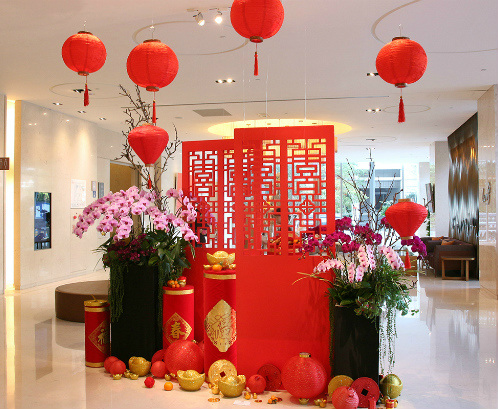
Millennium Taichung was decked out with beautiful festive decorations, including lanterns, gold ingots, orchid blossoms and intricately cut Chinese screen doors.
A festive celebration is also not complete without decorations! Many decorations are red, as the colour symbolises happiness and good fortune. Paper cutting (窗花) is a traditional craft that is especially prominent during the Spring Festival. These paper cuttings are made using red paper and intricately designed with auspicious symbols and words, or animals from the Chinese zodiac and other mythical creatures such as dragons and phoenixes. Calligraphy is also popular, with spring couplets (春联) and auspicious words written in Chinese calligraphy to hang on walls and doors.
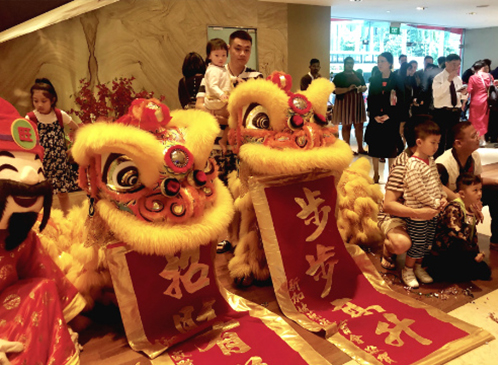
Guests, and especially children, were excited to get up close with the lions at M Hotel Singapore.
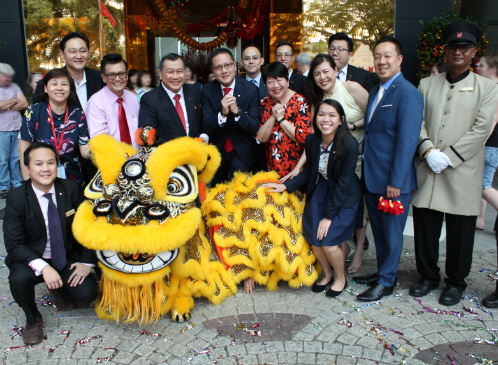
The team at Grand Copthorne Waterfront, with General Manager Mr Cheong Hai Poh (5th from left), posing with the lion after the ushering in of the Year of the Pig.
The festive season is also a great way for companies to show appreciation for staff, and often hold their annual company lunch or dinner around the Lunar New Year period. In addition to tossing for prosperity with lohei, and enjoying good food, fun and games, companies also use this opportunity to thank long-serving staff.
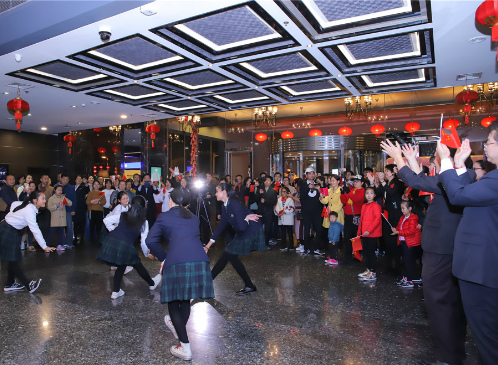
For a twist on the usual Spring Festival activities, Millennium Harbourview Xiamen instead organised a musical flash mob with students from Xiamen Music School, who put up enchanting song and dance performances for guests in the lobby.
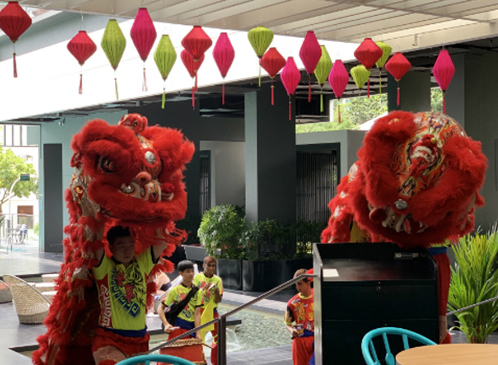
The lions at Studio M Singapore also did a walkabout around the hotel premises, as a way of bringing prosperity to all the areas of the hotel.
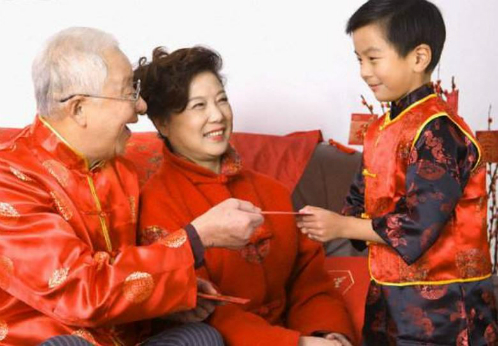
Red envelopes, or hongbao in Chinese usually presented by parents and grandparents as cash gifts to children during Chinese New Year, is one of the most recognised traditions observed during the Festival.
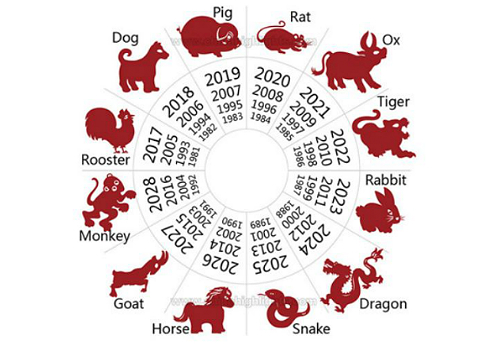
The Chinese zodiac is based on a 12-year cycle, with each year represented by an animal and its attributes. It is believed that people born in that year have similar personality traits of that animal. According to the 2019 Chinese zodiac, the year of the Pig begins on 5 February 2019 to 24 January 2020. Character traits are being calm, loyal, lazy and gullible.
