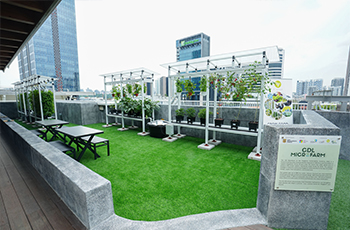
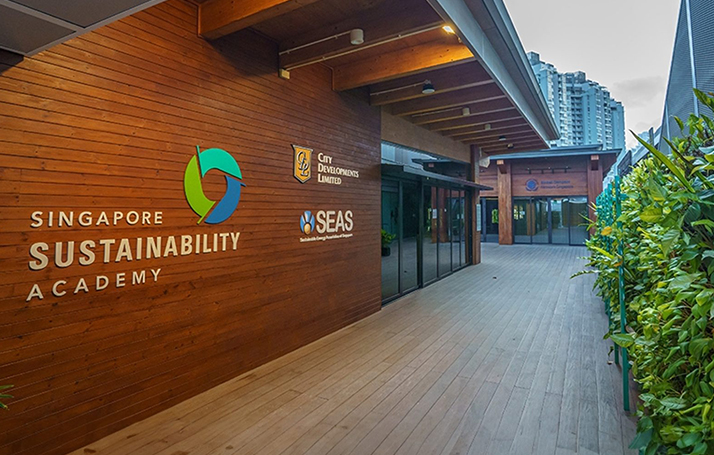
 The graduation ceremony of CDL's first SME Supplier Decarbonisation Queen Bee Programme was held at the Singapore Sustainability Academy (SSA), a dynamic hub designed and built by CDL with industry partners in 2017.
CDL Leads
The Way In
Advancing
SME Sustainability
And Decarbonisation
Small and medium-sized enterprises (SMEs) play a critical role in Singapore’s transition towards a low-carbon future, and City Developments Limited (CDL) is helping to lead the way.
In October 2025, 42 SMEs graduated from the inaugural SME Supplier Decarbonisation Queen Bee Programme, a six-month initiative launched by CDL in 2024 with the support of Enterprise Singapore and in collaboration with sustainability consultancy, Global Green Connect.
Designed to support CDL’s SME suppliers, the programme equips participants with the tools and knowledge to develop a decarbonisation road map, adopt carbon accounting practices, and align with recognised global frameworks such as CDP and the Science Based Targets initiative. These capabilities enable SMEs to better measure, manage and reduce their carbon emissions—while strengthening their long-term business resilience.
Building Capability at Both Company and Product Levels
At the programme, participants learnt to assess emissions across two key tracks: corporate-level emissions and product life-cycle emissions.
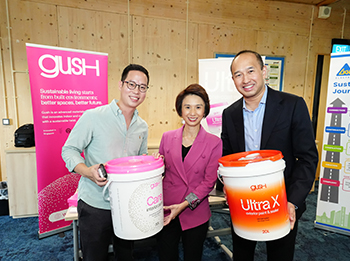 Co-founder and CEO of Gush Mr Lester Leong (left) showcasing his products to Senior Minister of State Ms Low Yen Ling (centre) and CDL Group CEO Mr Sherman Kwek (right).
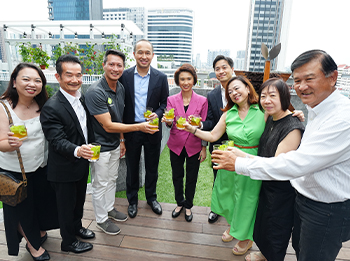 SMS Low (centre) together with representatives from CDL’s senior management team, CBM Pte Ltd and V-Plus Agritech, toasting with a mocktail that contains ingredients from the CDL MicroFarm.
Mr James Yin, Chief Executive Officer of agriculture solutions firm V-Plus Agritech, shared that the programme helped his team understand carbon data “from cradle to grave”—from upstream suppliers through to product disposal.
“One track is the entity level – what are your carbon emissions as a company? The other is the product level. You analyse the product based on the life cycle, from the cradle to the grave – basically from upstream suppliers and how they get raw materials, all the way to disposal,” he explained. “We can then extrapolate what selling a certain number of products means in terms of carbon emissions,” he added.
He added that sustainability reporting is becoming increasingly important as more potential partners require credible data as part of their decision-making.
For Mr Lester Leong, Co-founder and CEO of paint company Gush, the programme helped bridge the gap between intention and execution.
He shared, “Gush’s performance decorative coatings improve indoor air quality and cut operational energy use, yet we lacked a rigorous understanding of our carbon footprint for each product and how we’re benchmarked on a corporate level. It bridges the gap between a good sustainability story and verifiable, investor-grade metrics.”
Through one-on-one advisory sessions, Gush developed a decarbonisation road map that was both ambitious and practical. This has already led to operational improvements, including more efficient logistics planning to reduce freight-related emissions.
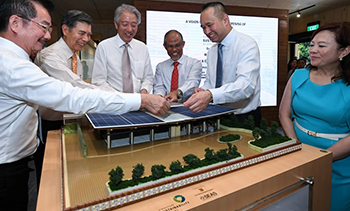 Mr Teo Chee Hean, former Deputy Prime Minister and Coordinating Minister for National Security (third from left), officially opened the Singapore Sustainability Academy (SSA) and was accompanied by Mr Masagos Zulkifli (third from right), then Minister for the Environment and Water Resources, Mr Sherman Kwek, CDL Group CEO (second from right), Mr Edwin Khew, SEAS Chairman (second from left), Mr Chia Ngiang Hong, CDL Group General Manager (first from left) and Ms Esther An, CDL Chief Sustainability Officer (first from right).
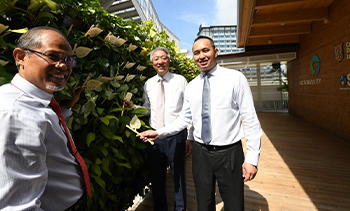 At the green wall outside SSA, former DPM Teo, Minister Masagos and Mr Kwek placed the name plates, bearing the logos of the National Climate Change Secretariat (NCCS), Ministry of the Environment and Water Resources (since renamed in 2020 as Ministry of Sustainability and Environment of Singapore) and CDL. Both NCCS and MEWR are two of the six supporting government organisations of SSA.
CDL Group Chief Executive Officer Mr Sherman Kwek said, “To achieve Singapore’s net-zero goals, SMEs play a critical role. With large corporates striving to meet stringent carbon reporting requirements, there is a stronger business case for SMEs to embrace carbon reduction.”
Why SMEs Matter in the Net-Zero Transition
CDL Chief Sustainability Officer Ms Esther An shared that the world will not be able to achieve net zero without SMEs. SMEs make up more than 99% of enterprises in Singapore and contribute over 40% of the nation’s greenhouse gas emissions, underscoring their importance in achieving national net-zero targets.
She said, “As a big player and procurer, we want to empower SMEs too. My ultimate objective is to get the suppliers to give us Scope 3 data that is credible, because right now there is a lack of available data,” Ms An said, adding that carbon accounting is a new concept for many SMEs.
The built environment accounts for a large portion of carbon emissions, energy and water consumption, waste and materials extracted from nature. Since Singapore relies heavily on imports, it is important to look at how businesses design products and what materials they procure.
“We need to look at upstream and downstream (activities in a supply chain), and we need to account for the carbon footprint in terms of not just energy but also circularity. We are looking at the whole loop, and this requires a lot of resources and data,” she added.
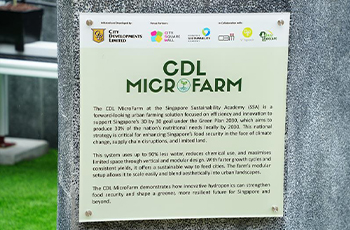
The CDL MicroFarm exemplifies how CDL supports SME graduates in applying sustainability solutions beyond the classroom.
Looking Ahead
The SME Supplier Decarbonisation Queen Bee Programme comprised tailored consultations, workshops and tutorials conducted on a one-on-one basis. Based on feedback from the inaugural cohort, CDL will be shortening future runs to 14 weeks, while maintaining the same outcomes.
Looking ahead, CDL plans to expand the programme beyond carbon accounting to cover broader sustainability and governance topics to help SME partners strengthen their overall ESG readiness.
Through these initiatives, CDL continues to work closely with its partners to build a more sustainable, resilient and future-ready value chain together.