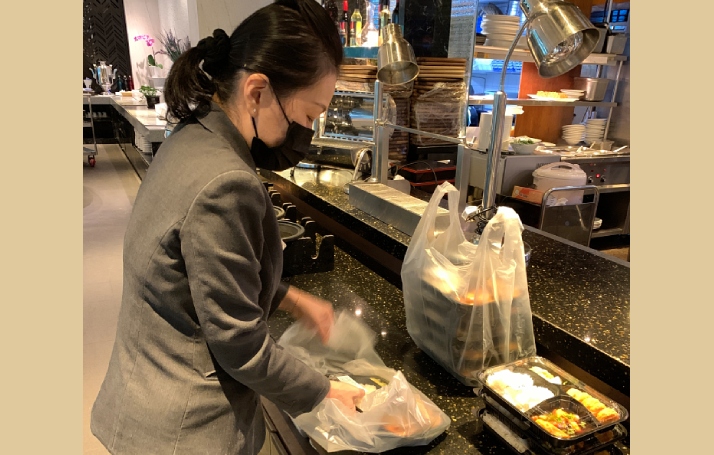
 M Hotel Restaurant Manager Ms Amelyn Ang packing bento boxes set aside for donation to the less fortunate.
Proposed Good
Samaritan Law
Can Boost Food
Donations To
The Hungry In
Singapore
A Good Samaritan law for food donations could be passed, allowing more businesses, such as hotels and restaurants, to donate surplus food to the needy instead of donating them.
Results of a recent public consultation on the Good Samaritan law found that 80% of respondents were in support of businesses that donate unsold and excess food being exempted from liability as long as their contributions comply with safety and hygiene laws at the point of giving.
This Good Samaritan law aims to cut Singapore’s food waste problem, which has grown by about 20% over the past decade, according to The Straits Times.
In Singapore, 665,000 tonnes of food waste were generated in 2020, according to the National Environment Agency (NEA). At the same time, a 2020 study by The Lien Centre for Social Innovation at Singapore Management University found that about 10% of Singaporeans struggled to get sufficient, safe and nutritious food at least once in 12 months. Among this 10%, two out of five households found it a challenge to get such food at least once a month.
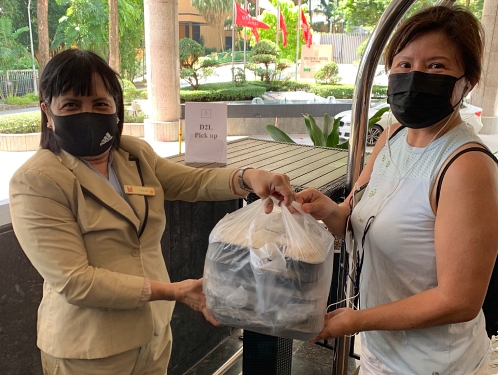
Millennium Hotels and Resorts were among Singapore’s hotels and food charities that are supportive of this proposed law, and are already donating its excess food to a Divert for 2nd Life (D2L), a community organisation that helps to rescue and divert excess prepared food. The six hotels – Orchard Hotel, Grand Copthorne Waterfront, Copthorne King’s, M Hotel, M Social and Studio M – donate excess prepared bento boxes for house guests as well as excess raw ingredients and dry food. The food is set aside and immediately packed and stored according to NEA regulations, with pick-ups done by D2L volunteers at least once a day. The volunteers then deliver the deliver the food items to those in need, such as rental flat residents or lower-income families, with advice from the hotels for the beneficiaries to consume the food within four hours.
The hotels also comply with all NEA regulations and enforce high food hygiene and safety standards, with regular laboratory tests done to ensure no high risk of bacteria count. As an added precaution, the hotels send high-risk food, such as unfinished cooked dishes or raw ingredients that are more prone to contamination, to its on-site digesters instead. These digesters help to reduce the hotel’s total food waste in a sustainable manner, turning the waste into water which is then used for cleaning or gardening.
Currently, the six hotels donate over 800 bento boxes, and recycle through the food digesters about 6,790kg of food waste (equivalent to about a bowl of rice per day a year for 100 people.