Mr Andy Tan, Millennium Hotels’ Senior Vice President, Global Operations and Partnership said Copthorne King’s Hotel tackled labour shortage by leveraging technology and staff training to turn challenges into opportunities. Built in 1970, the 311-room hotel has more than 106 employees.
Overcoming
Manpower Woes
With
Technology
And Staff
Reskilling
The pandemic has dealt a heavy blow on the global tourism industry for a good three-year period. While the appetite for travel is rising as the world eases border restrictions, some industry analysts foresee it might take at least another year for occupancies to return to pre-Covid levels.
The road to recovery remains tough but one hotel, Copthorne King’s Hotel has been tenacious by being adaptable and opportunistic as they continuously evolve and re-invent themselves to survive.
Mr Andy Tan, Millennium Hotels’ Senior Vice President, Global Operations and Partnership shares how the hotel turned to technology and retraining to tackle manpower woes and operate at reduced capacity. This article was first published in digital newspaper, TODAY Online on 31 July 2022.
 Good service always starts with the human touch. Yet a key conundrum facing our sector is finding the right people. Our industry has always been labour intensive due to the various services provided.
Globally, hotels have traditionally employed foreign workers for rank-and-file roles to complement locals. As a result, manpower challenges have persisted over the years when non-locals return home.
In Singapore, this is perpetuated by the increasing difficulty in attracting local talents due to the long hours and unattractive salary. The pipeline of students joining the industry is limited as enrolments at hospitality schools fall year-on-year.
This manpower crunch was exacerbated by the pandemic, and business at Copthorne King’s Singapore has been badly impacted. We had to function at reduced occupancy due to the lack of room attendants. The food and beverage (F&B) teams also ran with shorter operating hours to help manage costs.
We turned to technology and improved the capabilities of our existing team to alleviate these challenges. We deployed robots in our restaurants and implemented a mobile app which notified housekeepers on the rooms ready to be cleaned, reducing the need to knock on each door.
 Copthorne King's egg chef robot AUSCA at Princess Terrace Café prepares sunny-side up eggs or omelette style for guests at an average time of two and a half minutes.
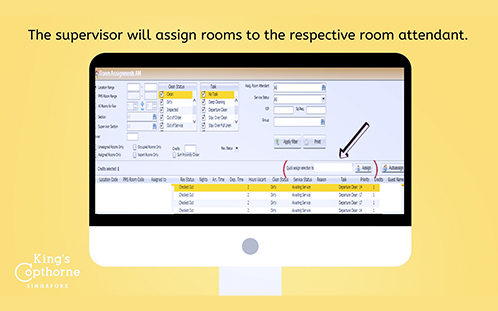 A mobile housekeeping app that includes tracking of uniforms and linen, also notifies housekeepers on the rooms that are ready to be cleaned. This system reduces the number of housekeeping by 2.5 employees, no missing linen, and a more efficient turnover of rooms.
At the same time, we looked within the organisation. We collaborated with Workforce Singapore to redesign jobs and reskill some of our employees under the Career Conversion Programme (CCP).
Through this, 12 employees were cross-skilled so that they could support various operational functions, including security, call centre and reservations. This benefited the overall hotel group as staff could be cross deployed to other hotels when needed.
We had a reservation executive whose former primary role was to manage customer and corporate bookings.
When guest reservations dipped during the pandemic, we put her through the CCP and in December 2020, she was promoted to be a duty manager, in charge of security, call centre, as well as reservations.
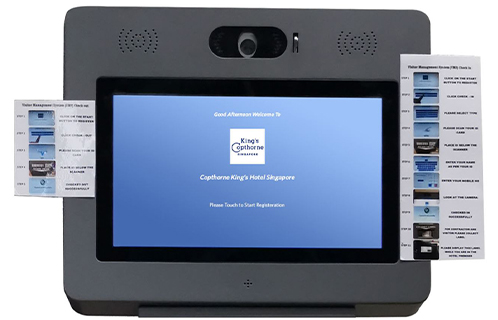
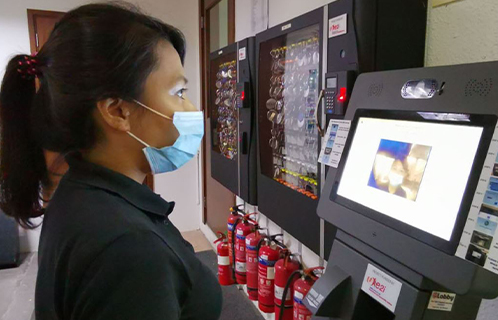
To improve guest flow and reduce wait times, the Visitor Management System (left photo) uses contactless facial recognition and ID scanning to collect visitor data efficiently (right photo). This real-time tracking system notifies the hotel’s Security Manager of the guest’s check-in and check-out times, and is compliant with the Personal Data Protection Act (PDPA).
In the first half of this year, we hired 30 new staff through job portals and employee referrals. These were for full-time roles, including F&B executives, room attendants, and maintenance engineers.
Six in ten of them are locals. Each hiring takes about 1.5 to two months, from posting of the jobs, to interviews and approvals. This excludes their notice period if they are employed.
We are still looking to hire another 10 to 12 staff in the areas of front office, F&B and housekeeping, and are considering a mix of casual labour like students on vacation, and contract staff.
The hospitality sector is dynamic and exciting. With developments in technology and guest experience, new and interesting roles such as digital transformation will open to provide many potential career pathways for staff.
As Singapore strengthens its position as a global tourism hub, we will continue our efforts to retain, reskill and hire local talents.
 The cash counting machine allows quick withdrawal of cash in high volumes and reduces human error. Only staff with access card, login and password are able to make such withdrawals.
 A user-friendly and automated electronic key management system that is a fuss-free process for hotel staff to monitor the movement of keys via scanning of thumbprint for key collection and return.