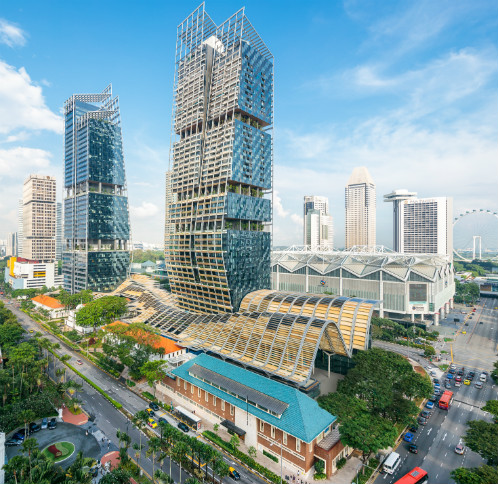
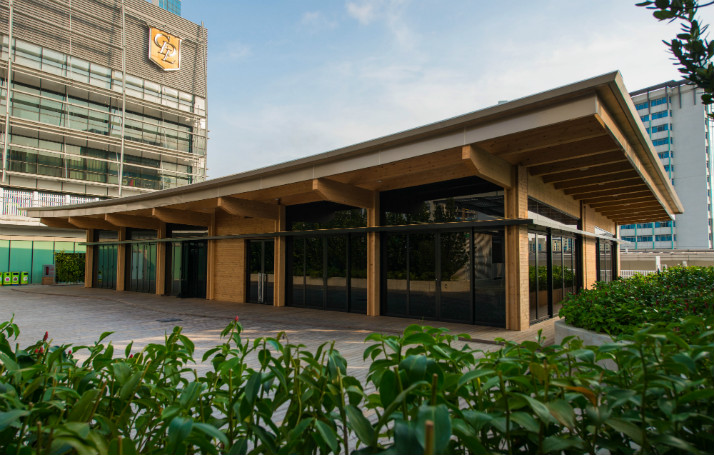
 A first-of-its-kind sustainable building in Singapore developed by CDL, the Singapore Sustainability Academy at City Square Mall is built using Cross Laminated Timber and Glued Laminated Timber verified to have come from responsible sources. The zero-energy building features solar technology with about 3,200 square feet of photovoltaic panels.
CDL
Accelerates
Climate Change
Strategy
With Singapore’s impending carbon tax in 20191 and the global transition to a low carbon economy, CDL has accelerated its climate change strategy. It is the first real estate company in Singapore to have its carbon reduction targets assessed and validated by the Science Based Targets Initiative (SBTi), which is fast becoming standard business practice among top global companies.
A collaboration between CDP, the United Nations Global Compact, World Resources Institute and World Wide Fund for Nature (WWF), SBTi is also one of the We Mean Business Coalition initiatives. It helps companies to establish and validate science-based carbon reduction targets that are in line with climate science to limit global warming to below 2°C, as set out by the Paris Agreement. These targets enable companies to stay ahead of increasing regulations, strengthen investor confidence and drive efficiency and profitability through innovative low-carbon solutions.
Having set its science-based targets, CDL will reduce its greenhouse gas (GHG) emissions per square metre2 across its Singapore operations (Corporate Office, commercial and industrial buildings) by 59% from base-year 2007 by 20303. For its development projects, CDL also commits to use sustainable building materials, instead of their conventional equivalents, to reduce embodied carbon4 by 24% by 2030. In addition, CDL will engage its subsidiary, Millennium & Copthorne Hotels plc, which contributes close to 90% of emissions from CDL’s key subsidiaries, to set a science-based emissions reduction target by 2025.
Recognising the financial implications and business risks of climate change, CDL has also embarked on a climate change scenario analysis, as recommended by the international Task Force for Climate-related Financial Disclosures (TCFD). CDL is one of the pioneering Singapore listed companies to pledge its support for the TCFD when it was first launched in June 2017.
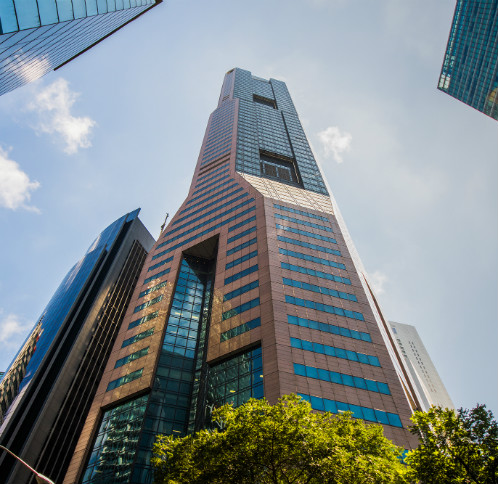
In addition, CDL has become the first company in Singapore to attain ISO 16745, by releasing the carbon intensity disclosure for its flagship building Republic Plaza in the heart of the city’s Central Business District. To further enhance the management of emissions from the building sector, ISO 16745 was developed to measure the carbon footprint of buildings. The standard verifies and reports carbon metrics for emissions arising from the buildings’ activities and provides accurate performance baselines. This helps to drive “Advancing Net Zero”, the World Green Building Council’s global project to achieve net zero carbon for all buildings by 2050.
Mr Sherman Kwek, CDL Group Chief Executive Officer, said, “Accounting for about a third of global GHG emissions, the building and construction sector has a critical role in shaping a low carbon economy. CDL has proactively implemented initiatives for low-carbon operations. To accelerate our climate action, we have adopted the science-based emissions reduction targets and climate change scenario analysis. These efforts help to future-proof our business by identifying risks for mitigation and adaptation. CDL will continue to explore low-carbon technologies and materials, renewable energy and emission reduction initiatives to enhance climate resilience.”
More information on CDL’s sustainability efforts can be found at www.cdlsustainability.com.
1 Large emitters will pay between S$10 and S$15 per tonne of carbon emissions by 2030, starting with S$5 per tonne from January 2019.
2 CDL will reduce Scope 1 and 2 GHG emissions per square metre of its Singapore operations. Scope 1 includes direct emissions which occur from sources that are owned or controlled by the company, for example, emissions from combustion in owned or controlled boilers, furnaces, vehicles, etc. and emissions from chemical production in owned or controlled process equipment. Scope 2 includes indirect emissions due to purchased electricity consumed at CDL’s Corporate Office, commercial and industrial buildings.
3 As of end 2017, CDL achieved a 35% reduction in GHG emissions, on track to meet its 2030 target.
4 Embodied carbon of construction materials includes the GHG emissions arising from the manufacture, transport, assembly, replacement and deconstruction of building materials.